This help document answers the following questions about using operators on MGI query forms:
See also:
Operators narrow or expand the effect of a search. They usually appear on selection lists located next to a field. Clicking the down arrow lets you see all available options.
One set of operators is comprised of begins, = (equals), ends, contains, and like; you can use these, for example, to filter what you are looking for.
Another set of operators lets you establish a relationship among values: between, equal to (=), less than (<), greater than (>), less than or equal to (<=), greater than or equal to (>=), not equal to (<>). These operators are useful for defining a ballpark search region when you are entering genome coordinates on MGI query forms (Genes and Markers, Alleles, SNPs, Sequences, Gene Expression, Probes, and so on). The is null operator defines an empty list; the is not null defines a set in which the contents are unknown.
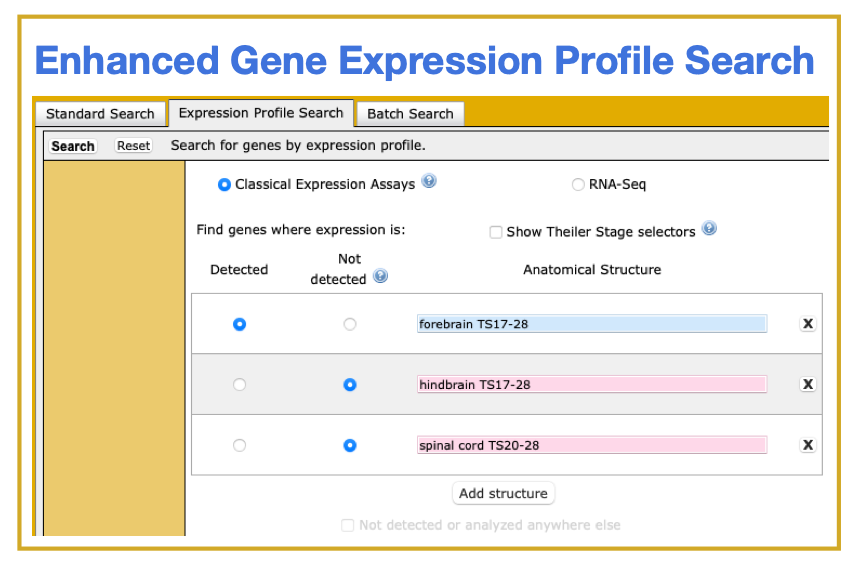
The operators in/not in or on/not on, let you specify the presence or absence of values. As examples, you can use them to include or exclude specific chromosomes when searching for SNPs annotated to mapped markers or to include/exclude developmental stages when searching for gene expression
Sometimes operators are activated by check marks: for example, clicking a NOT box puts a check mark beside a field or a list to choose items from to exclude from your search.
Back to TopMouse Genome Database (MGD), Gene Expression Database (GXD), Mouse Tumor Biology (MTB), Gene Ontology (GO), MouseCyc |
||
|
Citing These Resources Funding Information Warranty Disclaimer & Copyright Notice Send questions and comments to User Support. |
last database update 08/07/2008 MGI_4.11 Web browser compatibility |
|
|
|
||