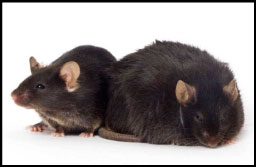
Atp7aMo-br
Spontaneous Allele Detail
|
|
| Nomenclature |
|
Symbol:
|
Atp7aMo-br
|
|
Name:
|
ATPase, Cu++ transporting, alpha polypeptide;
brindled
|
|
MGI ID: |
MGI:1856098 |
|
Synonyms: |
Br, Mobr |
|
Gene:
|
Atp7a
Location:
ChrX:106027276-106124926 bp, + strand
Genetic Position: ChrX,
47.36 cM
|
|
Atp7aMo-br/+
Show the 2 image(s) involving this allele.
|
 |
|
Mutation origin |
|
Mutation description |
|
Allele
Type: | |
Spontaneous |
|
Mutations: | |
Intragenic deletion, Single point mutation |
| |
|
Mutation details: Two significant nucleotide changes were noted in the brindled mouse. A 6 bp in frame deletion in exon 11 removed a leucine and an alanine at positions 799 and 800 from the encoded protein. A G-to-A transition mutation was also detected at codon 514 that altered a threonine to alanine, but this alteration is in a region unlikely to affect function. The deletion is in a region postulated to affect Cu transport activity. Western blot analysis demonstrated that a normal sized protein was made from this allele at levels comparable to wild-type. (J:38978, J:41388)
|
|
Inheritance: | |
Semidominant |
|
Phenotypes
|
View phenotypes for all genotypes (concatenated display).
|
|
Disease models
|
|
| Find Mice (IMSR) |
Mouse strains and cell lines available from the
International Mouse Strain Resource
(IMSR)
|
|
Notes |
Heterozygous females are very similar to Atp7aMo/+ females in appearance but have normal viability. They have curly vibrissae, but the coat is not noticeably waved. Hemizygous males are almost devoid of pigment except in the eyes and ears. The vibrissae are strongly curled, and the coat is wavy. The abnormalities of hair structure have been described by Gr\"uneberg (J:5137).
Males usually die when 2 weeks old, but a few have lived and been fertile. They have a behavioral abnormality consisting of a slight tremor, uncoordinated gait, and clasping of the hindfeet when held up by the tail (J:249, J:164). Females homozygous for Atp7aMo-br, and also heterozygous Atp7aMo-br/Atp7aMo and Atp7aMo-br/Atp7aMo-to females are identical in phenotype to hemizygous Atp7aMo-br males and die at the same age (J:164, J:12963).
Histological examination of the brain of brindled males shows widespread neuronal degeneration in the cerebral cortex and thalamic nuclei and scattered degeneration in the cerebellum (J:6113). Heterozygous females have been shown to have neurochemical abnormalities as well (J:2026). In contrast to mice bearing other Atp7a alleles, brindled mice have no aortic lesions (J:12963) and no defect in crosslinking of collagen and elastin. Brindled males do, however, have a 30 to 40% reduction in lysyl oxidase activity in skin (J:5777). They have reduced synthesis of noradrenalin by dopamine--hydroxylase in the brain and peripheral nervous system (J:5323), and decreased activity of cytochrome C oxidase and superoxide dismutase (J:5830). These enzymes are all copper-dependent or copper-containing, and their reduced activity may be due to defective copper transport in cells of all affected tissues (J:5956, J:617, J:5747, J:12937).
Brindled males have defective placental transport and defective intestinal absorption of copper. Copper concentration is high in gut mucosa, kidney, and testis and low in liver, brain, plasma, and most other organs (J:6204, J:6206). Concentration of the copper-binding protein metallothionein in various tissues is correlated with the concentration of copper (J:7370); however, hepatic metallothionein is inducible at normal levels in mutant neonates (J:24041). Parenteral injection of copper at 7 to 10 days of age has a striking therapeutic effect; it prevents tremor and early death, allows normal pigmentation, improves growth, produces normal concentrations of copper in organs previously deficient (except liver), produces normal activity of some copper-dependent enzymes (J:6205, J:7521), and prevents neuronal degeneration (J:6544). In heterozygotes with tabby (Eda), Atp7aMo-br resembles Atp7aMo-blo, and thus appears to act on coat color through an effect in hair follicles (J:5238).
|
| References |
|
Original: |
J:13041
Fraser AS et al.,
"Mottled, a sex-modified lethal in the house mouse."
J Genet 1953;51():217-221
|
|
All: |
48 reference(s)
|
|
|