About   Help   FAQ
MGI has a job opening for a biologist.
Genes, Genome Features & Maps
MGI provides access to integrated data on mouse genes and genome features, from sequences and genomic maps to gene expression and disease models.
Access Data
Search for genes and genome features by symbol, name, location, gene ontology classification or phenotype.
Genes & Markers Query
Use BLAST to search for mouse genes and genome features using nucleotide or protein sequences.
MouseBLAST
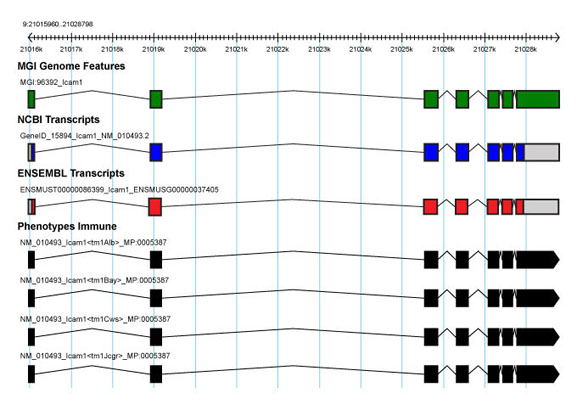
Create a display of regions of the mouse genome.
Mouse Genome Browser
Input a list of gene IDs or symbols and retrieve other database IDs and gene attributes (e.g. phenotypes, GO).
Batch Query
Download plain text files of all genes and markers in MGI.
Genes & Markers Reports (plain text)
Read the guidelines for mouse gene nomenclature.
Complete Guide to Nomenclature
Submit a new gene or genome feature and receive official nomenclature and an MGI accession identifier.
Gene/Genome Feature/Locus Nomenclature Form
FAQs
How do I...
.. search for genes, QTL, or other features in a specific genomic interval? FAQ
.. search for a gene using an Entrez, Ensembl, VEGA, or other accession ID? FAQ
.. search for all gene trap cell lines associated with a gene or marker? FAQ
.. retrieve Entrez gene, Ensembl, VEGA, or other IDs for a list of genes? FAQ
.. create a genome map from a genomic interval? FAQ
.. see different gene models along with the MGI-curated representative model? FAQ
More FAQs
Genes, Genome Features & Maps Includes
16 May 2012
37,449
Genes (including uncloned mutants)
29,063
Genes with nucleotide sequence data
24,842
Genes with protein sequence data
14,247
Genes with experimentally-based functional annotations
13,249
Genes with gene traps
More...
Genes, Genome Features & Maps News July 22, 2010
Genetic map position revision in MGI
  • The genetic map positions for genes and markers in MGI have been updated using the data and methods described in Cox et al. (2009) [PubMed: 19535546].
  • The revised standard genetic map described in Cox et al. incorporates over 10,000 single nucleotide polymorphisms (SNPs) using a set of 47 families of a heterogeneous mouse population comprising over 3500 meioses.
  • The revised map corrects errors in marker order in earlier consensus genetic maps for the laboratory mouse.
  • The Cox map was integrated SSLP markers from other genetic maps and with physical maps of the mouse genome.
  • Linear interpolation was used to translate mouse genome coordinates (NCBI Build 37) for genes and markers in MGI to sex-averaged cM locations.
  • Markers in MGI that did not have genome coordinates were not updated to new cM positions; however, the original mapping data for these markers can still be found in the mapping experiment detail pages.
Mapping data update summary
Genes and markers in MGI with interpolated cM locations: ~72,000
Genes and markers in MGI that gained a cM position following interpolation:~35,000
Genes and markers in MGI without an interpolated cM position (i.e. genetic map location = syntenic):~11,600
MGI-Mouse Genes, Genome Features & Maps: - Genes, Genome Features & Maps: About
Genes, Genome Features

MGI contains information about mouse genes, DNA segments, cytogenetic markers and QTLs. Each record may include the marker symbol, name, other names or symbols and synonyms, nomenclature history, alleles, STSs, chromosomal assignment, centimorgan location, cytogenetic band, EC number (for enzymes), phenotypic classifications, human disease data, Gene Ontology (GO) terms, MGI accession IDs and supporting references. See Interpreting a Genes and Markers Summary and Interpreting Gene Details for more information about the content of the display of a marker record as it appears in the query results.

Maps

MGI contains a variety of maps and mapping data. Users can create graphical displays of genome features on the mouse genome using the Mouse Genome Browser. A variety of types of Genetic Mapping Data are available from marker detail pages, including data from genetic linkage crosses, cytogenetic localization, recombinant inbred and recombinant congenic strains, and radiation hybrid mapping.


Contributing Projects:
Mouse Genome Database (MGD), Gene Expression Database (GXD), Mouse Tumor Biology (MTB), Gene Ontology (GO), MouseCyc
Citing These Resources
Funding Information
Warranty Disclaimer & Copyright Notice
Send questions and comments to User Support.
last database update
05/16/2012
MGI 5.00.10
Web browser compatibility
The Jackson Laboratory