Tnfrsf1atm1Blt
Targeted Allele Detail
|
|
| Nomenclature |
|
Symbol:
|
Tnfrsf1atm1Blt
|
|
Name:
|
tumor necrosis factor receptor superfamily, member 1a;
targeted mutation 1, Horst Bluethmann
|
|
MGI ID: |
MGI:1861040 |
|
Synonyms: |
p55-, p55TNFR-, R1KO, Tnfr10, TnfRI-, TNFRp55 |
|
Gene:
|
Tnfrsf1a
Location:
Chr6:125349362-125362484 bp, + strand
Genetic Position: Chr6,
59.32 cM
|
|
Mutation origin |
|
Germline Transmission:
|
Earliest citation of germline transmission:
J:14424
|
|
Parent Cell Line:
| E14 (ES Cell) |
|
Strain of Origin:
|
129P2/OlaHsd
|
|
Mutation description |
|
Allele
Type: | |
Targeted (knock-out) |
|
Mutations: | |
Insertion, Intragenic deletion |
| |
|
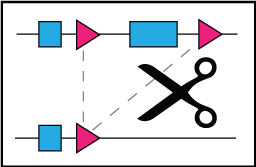
Mutation details: A neomycin cassette was used to replace the exons 2, 3, and a portion of 4. The affected exons code for the cysteine-rich domains I and II that are essential for binding of the ligand. (J:14424, J:92470)
|
|
Inheritance: | |
Recessive |
|
Phenotypes
|
View phenotypes for all genotypes (concatenated display).
|
|
Disease models
|
|
| Find Mice (IMSR) |
Mouse strains and cell lines available from the
International Mouse Strain Resource
(IMSR)
|
|
Notes |
Mice homozygous for this allele lack the type 1 receptor (J:14424). Mouse embryos produce TNF and its receptors (J:16646), and the evidence suggests that TNF is involved in important physiological functions. However, homozygous mutant mice develop normally and are fertile with normal litter sizes (J:21202). These mice resist toxicity of low dosage lipopolysaccharide treatment, mediated by the type 1 receptor, although they remain sensitive to high lipopolysaccharide doses. They are also more sensitive to infection with Listeria monocytogenes (J:14424). Cytotoxic T lymphocyte induction by TNF via Tnfrsf1a is not essential to the response to viral infection, homozygous mutant mice being capable of controlling viral infection normally. It is, of course, possible that the essential receptor molecule in these reactions is TNFRSF1B, or that TNFRSF1B can substitute for TNFRSF1A in the absence of the latter (J:21202). A differential response of mutant homozygotes to activation by mouse TNF, which can activate either TNFRSF1A or TNFRSF1B, and human TNF, which is selectively interactive with TNFRSF1A only, suggests that substitution can take place in some circumstances (J:21648). On the other hand, TNF inhibition of Csh2 expression is mediated through the TNFRSF1A, but not the TNFRSF1B, receptor (J:19617).
|
| References |
|
Original: |
J:14424
Rothe J et al.,
"Mice lacking the tumour necrosis factor receptor 1 are resistant to TNF-mediated toxicity but highly susceptible to infection by Listeria monocytogenes."
Nature 1993 Aug 26;364(6440):798-802
|
|
All: |
105 reference(s)
|
|
|