Phenotypes associated with this allele
|
|
| Find Mice |
Using the International Mouse Strain Resource (IMSR)
Mouse lines carrying:
Shox2tm1Ddu mutation
(1 available);
any
Shox2 mutation
(19 available)
Shox2tm3.1(cre)Ypc mutation
(0 available);
any
Shox2 mutation
(19 available)
|
|
|
mortality/aging
|
|
• no living fetuses are recovered at E14.5
|
|
|
• lethality is observed beginning at E11.5, increasing as development progresses
|
cardiovascular system
|
|
• the sinoatrial node (SAN) is hypoplastic at E11.5 similar to Shox2tm1Ypc homozygous embryos
|
muscle
|
|
• the sinoatrial node (SAN) is hypoplastic at E11.5 similar to Shox2tm1Ypc homozygous embryos
|
|
|
| Find Mice |
Using the International Mouse Strain Resource (IMSR)
Mouse lines carrying:
Shox2tm1.1Ddu mutation
(0 available);
any
Shox2 mutation
(19 available)
Shox2tm1Ddu mutation
(1 available);
any
Shox2 mutation
(19 available)
Tg(Prrx1-cre)1Cjt mutation
(2 available)
|
|
|
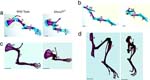
Limb phenotype of Shox2tm1Ddu/Shox2tm1.1Ddu Tg(Prrx1-cre)1Cjt mice
mortality/aging
|
N |
• provided adequate access to food and water homozygotes are viable
|
limbs/digits/tail
|
|
• development of the forelimb stylopod elements is severely impaired; however development of the forelimb zeugopd elements is similar to wild-type mice
|
|
|
• development of the hindlimb stylopod elements is severely impaired
|
|
|
• the hindlimb zeugopod is also shorter
|
|
|
• virtually absent at birth with only a small abnormal dorsal piece remaining that does not span the axis of the limb
|
|
|
• virtually absent at birth with only a tiny cartilage analage which lacks ossification is seen; in adults ossification is seen but little bone growth occurs
|
skeleton
|
|
• virtually absent at birth with only a small abnormal dorsal piece remaining that does not span the axis of the limb
|
|
|
• virtually absent at birth with only a tiny cartilage analage which lacks ossification is seen; in adults ossification is seen but little bone growth occurs
|
|
|
• hypertrophic chondrocytes eventually appear in the humerus but are in abnormal asymmetric locations blocking formation of the growth plate
|
|
|
• at E12.5, the humerus and femur cartilages are already significantly shorter (by about 50%) than in wild-type
• by E14.5 the humerus and femur cartilage malformation is as severe as in newborns
• chondrocyte differentiation in the humerus is impaired with markers for immature cells (Col2a1) still present at E18.5 and expression of later markers greatly decreased or absent
|



 Analysis Tools